


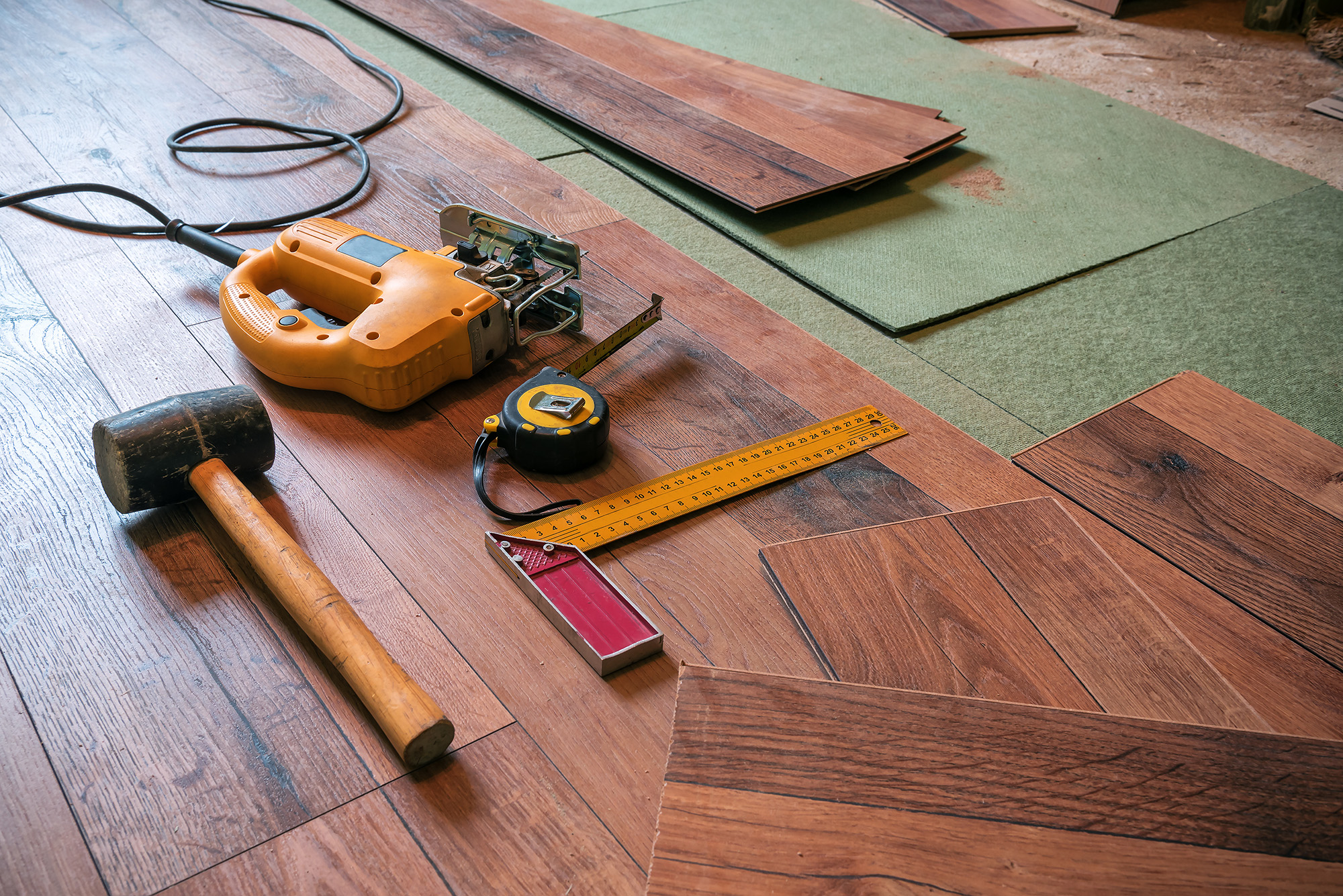
Spring in southeast Missouri means rising humidity, saturated ground, and the kind of moisture that creeps up through a slab or crawlspace long before any visible water appears. Hardwood reacts to that moisture by swelling, and when swelling planks have nowhere to go, they lift at the seams and buckle. Most homeowners blame the wood. The real culprit is usually what was or wasn't installed underneath it.
Underlayment is the thin layer between your subfloor and your finished floor, and in a humid, flood-adjacent climate it does the heaviest lifting of any component you can't see. The difference between a builder-grade foam and a proper moisture-managing underlayment is the difference between a floor that stays flat for decades and one that telegraphs every wet season.
Why The Vapor Barrier Matters More Here
Over a concrete slab, moisture vapor migrates upward constantly, even when the surface feels bone dry. Without a vapor barrier, that vapor reaches the underside of your wood, condenses, and feeds the cupping and crowning that ruin a floor from below. A quality underlayment with an integrated vapor barrier or a standalone 6-mil poly barrier beneath it, blocks that path entirely.
This is non-negotiable for engineered hardwood or laminate going over a slab in our region. The small upcharge for a vapor-barrier underlayment is trivial next to the cost of pulling up a buckled floor, drying the slab, and starting over. It's the cheapest insurance against the most common cause of premature floor failure here.
Choosing The Right Material For Moisture
Not all underlayment handles water the same way. Cork is excellent for sound and comfort but can hold moisture, making it a poor pick for flood-prone or below-grade spaces. Rubber and quality closed-cell foam with a moisture barrier shed water far better and recover more reliably after a damp season.
The right choice also depends on your installation. Floating engineered or laminate floors need a continuous underlayment to perform and to stay quiet underfoot. Nailed solid hardwood may use felt or rosin paper instead, but in a high-moisture home, even nailed floors benefit from a proper moisture break. Matching the underlayment to both the floor type and the local climate is what keeps planks flat when the humidity climbs.
At Legacy Floor & Tile, we spec underlayment for the way moisture actually behaves in homes across Van Buren, Poplar Bluff, Dexter, Doniphan, and Winona, MO — not by a generic national chart. Come see vapor-barrier and moisture-rated samples at Van Buren, MO and get a recommendation built for your subfloor. Contact us today to keep your hardwood flat through every wet spring to come.